The Philippines
It says something that six months of travel in the Philippines was not nearly enough for me to do everything I wanted to. But then again a whole lifetime would of course not be enough to fully explore this country of 7,000 islands. Its hundreds of tribal groups with their own languages and cultures inhabit the world’s most postcard-perfect tropical islands, white-sand beaches, stunning mountain scenery and virgin rainforest, some of them remaining “uncontacted” to this day. The endemic wildlife found on several islands, the spectacular diving and snorkelling opportunities, the dozens of wild, frenetic street festivals and the amazing lack of tourists should be attractions enough even for those not planning to get off the unbeaten track, especially considering this is one of the cheapest countries in the world to travel in and almost everyone speaks English.
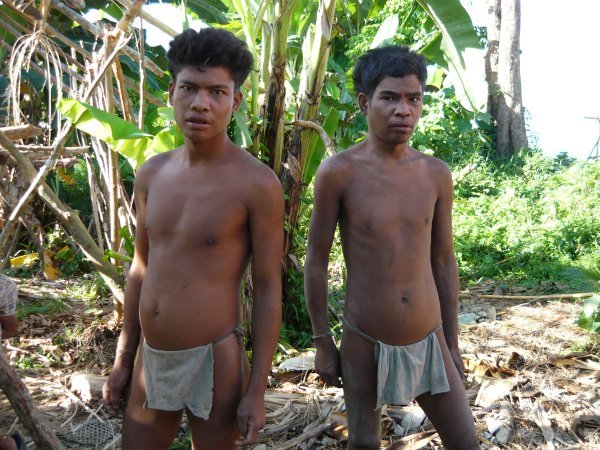
Two Batangan Mangyan men, interior Mindoro, the Philippines
Guide books to the Philippines, particularly the Lonely Planet, do a spectacularly poor job, leaving out many of the most interesting and exotic parts completely. As a result a very small proportion of the few tourists who actually come to the Philippines make it to the really exotic areas. Most stick to the three or four tourist “hot spots”. Only a small trickle of those with time and a sense of adventure make it to the more offbeat destinations written up in the Lonely Planet. Even fewer venture outside its pages altogether. As a result, some of the damning misconceptions I have heard from visitors and even long-term foreign residents of the archipelago include: “There are only one or two places of interest to tourists,” “There would be nothing to do there for longer than a month,” and “The place has no culture.” I hope to disprove all of these on this website!
The Philippines were a colony of the Spanish followed by the Americans. In the cities and towns things do feel very Americanised. Everyone dresses in shorts and T-shirts with shopping malls and burger restaurants everywhere. The misconception that the Philippines is not as exotic as other South East Asian countries comes from the fact that most tourists never get beyond these towns and cities, or tourist hot spots such as Boracay, El Nido and Sagada. In reality though there are tribal communities and remote villages where traditional dress, architecture and culture have been better preserved than in any other South East Asian country. Finding them just takes time, adventurousness and a willingness to go beyond the pages of the Lonely Planet.
The Spanish also left their mark on the architecture of the cities, the names and language of the people and, amongst other things, in a friendly, laid-back attitude, a love of fiestas and a strict Catholicism which nevertheless remains mingled with strong beliefs in plenty of indigenous spirits, demons and goblins. Many Filipinos, even educated businessmen in Manila, believe in psychic surgery, where the surgeon cuts open the patient with his bare hands, takes out negative energy and closes the wound leaving no trace on the skin. They will tell you in all seriousness about times when they have seen demons such as aswan, a winged legless man flying through the night.
Americanisation does have an advantage for the traveller though: almost all Filipinos speak reasonable English (along with their own local language and Tagalog, the country’s other official language). This means that getting around from one island to another, finding out boat timetables, buying stuff and meeting people in general is pretty easy. However, once you get off the unbeaten track to places such as interior Mindoro you find that no one in these isolated tribal groups speaks either Tagalog or English.
Kalinga, to the North of Manila, has spectacular mountain scenery with millennia-old rice terraces cascading down the slopes and a warrior-like culture. There are still people alive who took part in inter-village headhunting raids, men and women with full-body tattoos and inter-tribal warfare is still a common occurrence.
South Palwan also has beautiful mountain scenery covered in virgin rainforest that is home to plenty of very traditional and isolated tribal people who still hunt using blowguns.
The interior of the island of Mindoro is home to the Philippines’ most traditional tribal people, known collectively as the Mangyan. Several distinct groups make up the Mangyan, the most isolated of which remain “uncontacted” to this day.
The interior of Panay has beautiful mountain scenery, rice terraces and tribal villages with medicine men, singing debates, ritual machete fighting and historical chants memorised only by “princesses” who grow up locked in a single room. Communities of negritos, the Philippines’ black-skinned indigenous inhabitants, still exist too.
Far-flung Sibuyan has its own indigenous people who live in the virgin rainforest of the interior. It is more known, however, for the striking number of endemic species inhabiting those jungles.
Lake Sebu on Mindanao is home to the colourful T’boli people. Their traditional clothing, jewelry and hats can occasionally be seen during everyday life in nearby villages and particularly on special occasions such as weddings or their yearly festival in November. As well as the cock-fighting that is popular throughout the Philippines, the T’boli also practise horse fighting.
The place where the culture of the Philippines indigenous negritos has been best preserved is the Sierra Madre mountain range in the North of Luzon, the island on which the Philippines’ capital Manila is situated. Many of these groups still live isolated existences and wear loin cloths.
For beautiful beaches and tropical islands visitors can either head to the tourist hot spots of Boracay, El Nido, Puerto Galera, Pandan, Apo Reef or, for the more adventurous, try island hopping through the Visayas. Local fishermen will always be happy, for a small fee of US$5 – US$10, to drop you off on your own paradise tropical island and pick you up in the evening or the next day.
Those interested in psychic surgery can find plenty of clinics offering it in Manila, although try to get a recommendation first as some are considered authentic while others are considered conmen.
Travel around each island is by bus or jeepney, a type of flamboyantly-decorated converted US World War Two military jeep. Inter-island transport is by boat or air. Cebu Pacific, the Philippines’ low-cost airline, often offers seat at cheaper rates than the equivalent boat fare.
When traveling by boat it is also better to avoid smaller shipping companies or the tiny pump boats that link up smaller islands in, for example, the Visayas. They can be delayed by many days or even break down in the middle of open seas (both happened to me). Remember also that the Philippines also has the world’s worst record of shipping disasters, including one where 5500 people on an overcrowded ferry drowned, many times more than died when the Titanic sunk. Dozens of passenger boats sail every day and a handful sink each year, usually the smaller and less reliable companies. To minimise risk, try to stick to modern shipping lines such as SuperFerry.




Leave a Reply